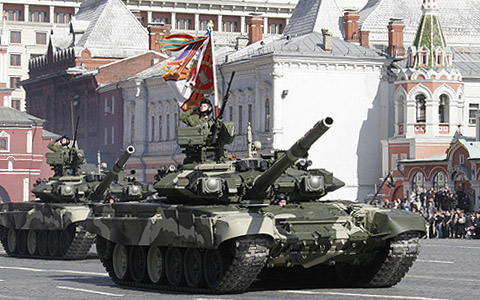
The T-90 is a Russian third-generation main battle tank that is a modernisation of the T-72 (it was originally to be called the T-72BU, later renamed to T-90). It is currently the most modern tank in service with the Russian Ground Forces and Naval Infantry. Although a development of the T-72, the T-90 uses a 125mm 2A46 smoothbore tank gun, 1G46 gunner sights, a new engine, and thermal sights. Standard protective measures include a blend of regular steel and Kontakt-5 explosive-reactive armor, laser warning receivers, Nakidka camouflage and the Shtora infrared ATGM jamming system. The EMT-7 electromagnetic pulse (EMP) creator is used in testing but not fitted to T-90s in active service. It is designed and built by Uralvagonzavod, in Nizhny Tagil, Russia.
Friday, March 11, 2011
Thursday, March 10, 2011
Tam Tank Pictures
The Tanque Argentino Mediano ("Argentine Medium Tank"), or TAM, is the main battle tank in service with the Argentine Army. Lacking the experience and resources to design a tank, the Argentine Ministry of Defense contracted German company Thyssen-Henschel. The vehicle was developed by a German and Argentine team of engineers, and was based on the chassis of the German Marder infantry fighting vehicle.
The TAM met the Argentine Army's requirement for a modern light-weight and fast tank with a low silhouette and sufficient firepower to defeat contemporary armored threats. Development began in 1974 and resulted in the construction of three prototypes by early 1977 and full-scale production by 1979. Assembly took place at the local 9,600-square-meter (103,000 sq ft) TAMSE plant, founded for the purpose by the Argentine government. Economic difficulties halted production in 1983, but manufacturing began anew in 1994 until the army's order of 200 tanks was fulfilled.
Argentine TAM VCA 155 Palmaria
A TAM VCTP, May of 2008.
The TAM series includes seven different variants, such as a 155 mm (6.1 inch) self-propelled howitzer and a self-propelled mortar vehicle. In total, over 280 such vehicles were built, including armored personnel carriers, artillery and mortar pieces. The TAM and VCTP were manufactured for the Peruvian Army, only to be integrated into the Argentine Army when Peru canceled the contract. The TAM also competed for other export orders, but the TAM was ultimately not exported.
The TAM has never seen combat, although 17 armored personnel carriers based on the TAM chassis were deployed to Croatia for the United Nations UNPROFOR peacekeeping mission.
Wednesday, March 9, 2011
M1 Abrams
The M1 Abrams is a third-generation main battle tank produced in the United States. It is named after General Creighton Abrams, former Army Chief of Staff and Commander of US military forces in Vietnam from 1968 to 1972. The M1 is a well armed, heavily armored, and highly mobile tank designed for modern armored ground warfare. Notable features of the tank include the use of a powerful gas turbine engine (fueled with JP8 jet fuel), the adoption of sophisticated composite armor, and separate ammunition storage in a blow-out compartment for crew safety. With a weight of close to 68 short tons (almost 62 metric tons), it is one of the heaviest main battle tanks currently in service.
The M1 Abrams entered U.S. service in 1980, replacing the 105 mm gun, full tracked M60 Patton. It did, however, serve for over a decade alongside the improved M60A3, which had entered service in 1978. The M1 remains the principal main battle tank of the United States Army and Marine Corps, and the armies of Egypt, Kuwait, Saudi Arabia, Australia, and in 2010 Iraq. It is anticipated to continue in U.S. service until the 2050s, approximately 70 years after adoption.
Three main versions of the M1 Abrams have been deployed, the M1, M1A1, and M1A2, incorporating improved armament, protection and electronics. These improvements, as well as periodic upgrades to older tanks have allowed this long-serving vehicle to remain in front-line service. The M1A3 is currently under development.
Tuesday, March 8, 2011
Leopard 2
The Leopard 2 is a German main battle tank (Kampfpanzer) developed by Krauss-Maffei in the early 1970s and first entering service in 1979. The Leopard 2 replaced the earlier Leopard 1 as the main battle tank of the German Army. Various versions have served in the armed forces of Germany and twelve other European countries, as well as several non-European nations. More than 3,480 Leopard 2s have been manufactured. The Leopard 2 first saw combat in Kosovo with the German Army and has also seen action in Afghanistan with the Danish and Canadian ISAF forces.
There are two main development batches of the tank, the original models up to Leopard 2A4 which have vertically-faced turret armour, and the "improved" batch, namely the Leopard 2A5 and newer versions, which have angled arrow-shaped turret appliqué armour together with a number of other improvements. All models feature digital fire control systems with laser rangefinders, a fully stabilized main gun and coaxial machine gun, and advanced night vision and sighting equipment (first vehicles used a low-light level TV system or LLLTV; thermal imaging was introduced later on). The tank has the ability to engage moving targets while moving over rough terrain.
Monday, March 7, 2011
M60 Patton
The 105 mm Gun Full Tracked Combat Tank, M60, is also known unofficially as the M60 Patton, and is a first-generation main battle tank (MBT) introduced in December 1960. It was widely used by the U.S. and its Cold War allies, especially those in NATO, and remains in service throughout the world today despite being superseded by the M1 Abrams. Egypt is currently the largest operator with 1,700 upgraded M60A3s, Turkey is second with more than 900 upgraded units in service, and Israel is third with over 700 units of Israeli variants.
Sunday, March 6, 2011
T-80
The T-80 is a main battle tank (MBT) designed and manufactured in the former Soviet Union. A development of the T-64, it entered service in 1976 and was the first production tank to be equipped with a gas turbine engine for main propulsion. The T-80U was last produced in a factory in Omsk, Russia, while the T-80UD and further-developed T-84 continue to be produced in Ukraine. The T-80 and its variants are in service in Belarus, Cyprus, Kazakhstan, Pakistan, Russia, South Korea, and Ukraine. The chief designer of the T-80 was the Russian engineer Nikolay Popov.
Saturday, March 5, 2011
M-84
The M-84 is a 2nd generation main battle tank manufactured by the Socialist Federal Republic of Yugoslavia. The M-84 is in service in Bosnia and Herzegovina, Croatia, Kuwait, Slovenia and Serbia.
Subscribe to:
Posts (Atom)